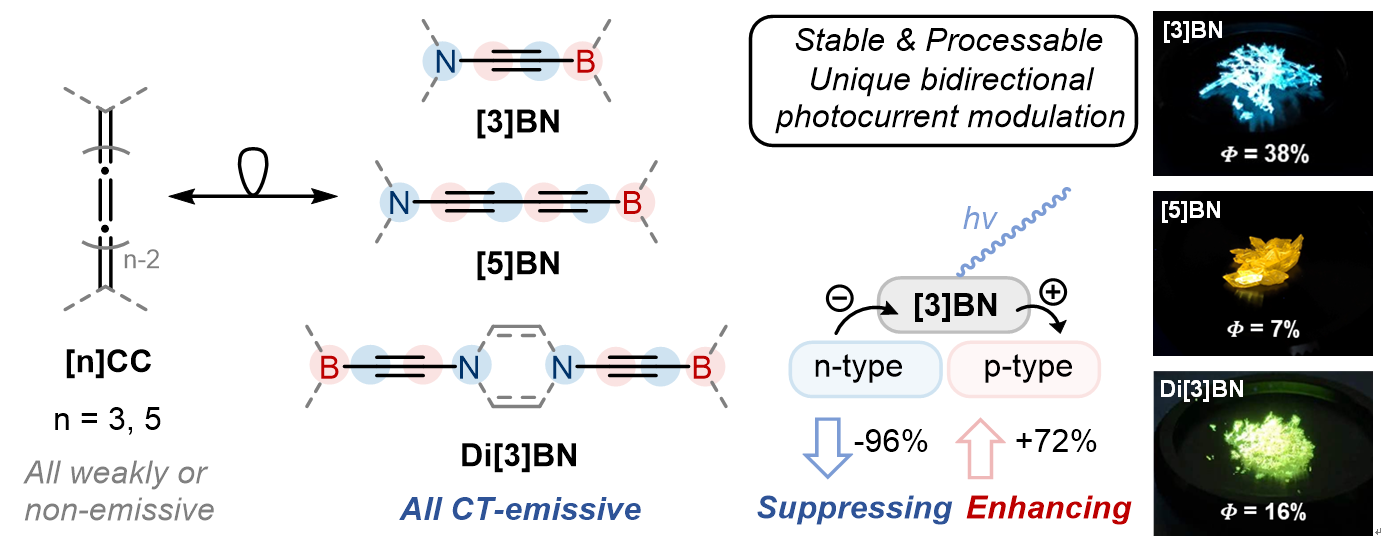
Cumulenes represent a unique class of conjugated molecules with C(sp)-rich backbones. However, efficient non-radiative decay associated with effective conjugation coordinate (ECC) vibrations severely limits their luminescence. Modulating the electronic structure therefore represents an attractive strategy for regulating their excited-state behavior. Here, BN embedding was employed to introduce intrinsic electronic polarization into cumulene frameworks. The resulting BN-capped cumulenes exhibit pronounced charge-transfer character, suppressed ECC vibrational relaxation, and excimer-like solid-state fluorescence, whereas the corresponding all-carbon cumulenes remain weakly or non-emissive. Furthermore, heterojunction devices based on [3]BN display unique bidirectional photocurrent modulation. These results demonstrate that BN embedding provides an effective strategy for tailoring the excited-state behavior and optoelectronic properties of cumulenes.
Yi-Ze Xu and Yong-Shi Chen contributed equally to this work.
This work was carried out through a collaboration between the Zhu Group and the Pei Group at Peking University.