As Artificial Intelligence continues to reshape our world, the hardware powering our smartphones and computers is hitting a massive "traffic jam". However, a groundbreaking discovery by Chinese scientists may have just found the key to clearing the path.
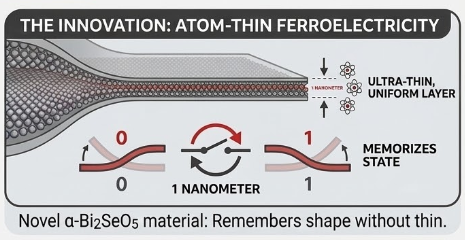
Professor Hai-Lin Peng and his research team at Peking University recently published a study in the journal Science, detailing their success in creating a new type of two-dimensional (2D) ferroelectric oxide called α-Bi₂SeO₅. This material, which is only a few atoms thick, is poised to solve the most persistent energy and longevity headaches in the semiconductor industry.
The "Data Bottleneck" in Our Digital Cities
To understand this breakthrough, imagine the chip inside your computer as a bustling city:
The Computing Center (Processor) handles the heavy lifting.
The Warehouse (Memory) stores all the information.
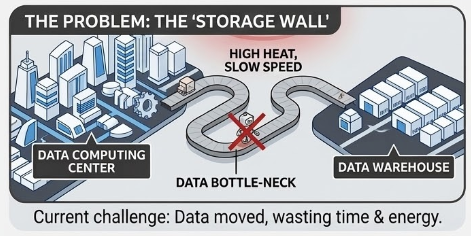
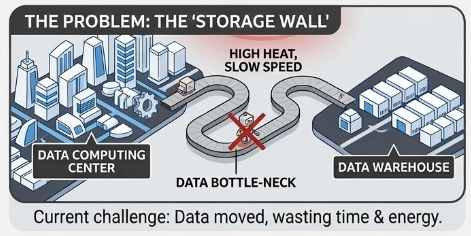
In current chip designs, these two hubs are physically separated. For every single task, "couriers" must travel back and forth between the center and the warehouse. As AI demands more data, these couriers are becoming overwhelmed, leading to massive traffic jams (slow speeds) and extreme overheating (high energy consumption).
Scientists refer to this roadblock as the "Memory Wall" and the "Power Wall".
The "1-Nanometer" Memory Miracle
To break these walls, researchers have long sought "ferroelectric materials"—substances that act like a switch with a memory.
If a material can process data and store it in the same spot, the couriers don't need to travel anymore. However, traditional ferroelectric materials have a fatal flaw: once they are scaled down to be thin enough for modern chips (under 5 nanometers), they lose their "memory" entirely.
The Peking University team has shattered this limit. Their new oxide offers three "superpowers":
Atomic Thinness: Even at a thickness of just 1 nanometer (roughly 1/100,000th the width of a human hair), it maintains a rock-solid memory.
Unrivaled Durability: While typical memory wears out over time, this material survived 1.5 trillion read-write cycles in the lab without any performance dip.
Ultra-Low Power: It operates at a very low voltage (0.8V), meaning future chips could consume dozens of times less power than they do today.
"This work breaks the thickness scaling limit of traditional materials", noted one international peer reviewer. "It opens the door to a new era of 'computing-in-memory' architecture."
Real-World Impact: A Week of Battery Life?
This isn't just a lab experiment; it has real implications for our daily lives.
If this material reaches mass production, our electronics could undergo a "genetic mutation." Imagine a smartphone that doesn't just run AI apps faster without getting hot, but also has a battery that lasts a week instead of a day. Furthermore, the extreme stability of the material means our devices could last much longer before needing replacement.
The Road Ahead
While the lab data is exhilarating, moving this "super material" from a university bench to a global factory line still involves significant engineering hurdles.
However, one thing is clear: Professor Peng’s team has illuminated a promising new path for the "More than Moore" era—a time when traditional chip-shrinking methods are reaching their physical limits.